
Steel Industry Encoders - Optimizing Motion Control in Harsh Environments

Posted by Social AMS on 22nd May, 2025
Encoders used in the steel industry must meet strict durability and technical standards due to the harsh and demanding nature of production environments. At AMS, we provide encoder solutions from Leine Linde, a brand now under Heidenhain following a strategic acquisition. In this article, we'll walk you through essential insights about encoder applications in the steel sector - don't miss the details below!
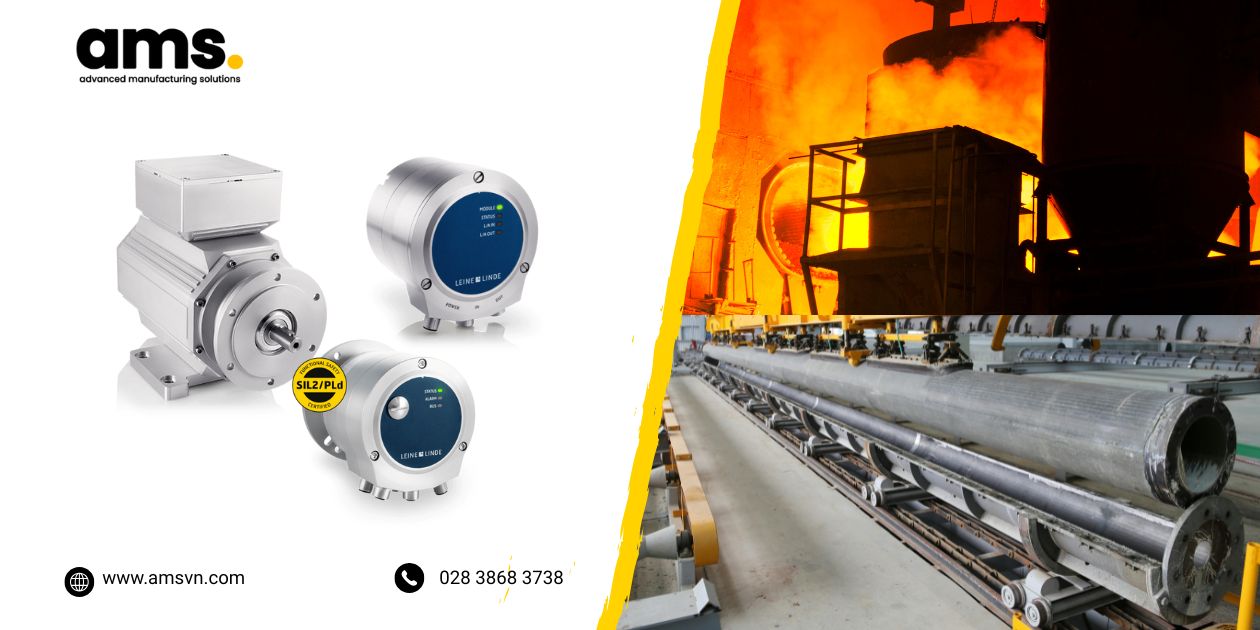
1. Overview of the Steel Industry and Motion Control Requirements
According to MB Securities (MBS), the average price of construction steel in 2025 is expected to reach $590/ton, up 7% from 2024, while box steel prices may increase by 2,000-3,000 VND/kg. A key driver is Vietnam's public investment strategy, with a 350,000 billion VND infrastructure stimulus package set to boost steel demand by 25% in 2025. Additionally, iron ore prices are forecasted to rise 5-7% due to growing demand from India and Southeast Asia.
As steel demand increases across various sectors, steel production facilities must scale up operations while ensuring precision and reliability. This leads to higher performance expectations for machinery and motion systems on the production floor. Equipment must endure dust, vibration, fluctuating temperatures, and continuous mechanical stress conditions that challenge even the toughest technologies.
In steel rolling mills, encoders play a vital role in monitoring roller shaft motor speed and adjusting roller height for precise material shaping. As production processes become more advanced, steel industry encoders have evolved into indispensable components for maintaining operational stability and precision.
Whether you're operating a hot rolling mill, cold rolling line, or continuous casting machine, you need robust feedback systems that thrive in extreme industrial environments. Encoders from Leine Linde, distributed by AMS, are designed specifically to deliver high-resolution feedback, shock resistance, and thermal stability - all essential for smooth, accurate control in steel manufacturing.
2. Key Challenges When Using Encoders in Steel Plants
Unlike other manufacturing environments, encoders used in the steel industry must operate under extremely harsh conditions, facing a range of mission-critical challenges that can threaten both equipment and production performance:
-
Excessive heat from hot rolling processes can damage encoder circuitry.
-
Metal dust and debris can clog sensors and interfere with accurate signal output.
-
Heavy vibration may distort encoder signals, leading to control errors or system shutdowns.
-
Lubricants and high humidity can compromise standard encoder housings, reducing service life and reliability.
These environmental stressors demand rugged, specialized encoders engineered for resilience.
Beyond environmental factors, human-related decisions also significantly affect encoder performance and overall production efficiency in steel manufacturing. Common causes of suboptimal outcomes include:
-
Choosing the wrong encoder type results in costly downtime, lost production hours, and excessive material waste.
-
Using low-cost Chinese encoders might seem economical at first, but these often come with hidden risks in terms of shorter lifespan, inconsistent accuracy, and frequent replacement needs.
In an industry where every minute counts, these decisions can lead to long-term losses in both productivity and quality.
>> See more: Why Heidenhain Encoders Are the Top Choice in Production Lines
3. Leine & Linde Solutions - Engineered for Heavy-Duty Steel Industry Applications
Leine & Linde is a globally recognized brand, known for providing encoder solutions tailored to demanding industrial sectors such as paper manufacturing, wind power, port logistics (cranes, hoisting, oil & gas), and especially the steel industry. Established in 1967, the company has continuously innovated to deliver high-value solutions for both OEMs and end-users worldwide.
Below are key product lines from Leine & Linde designed specifically for steel production environments:
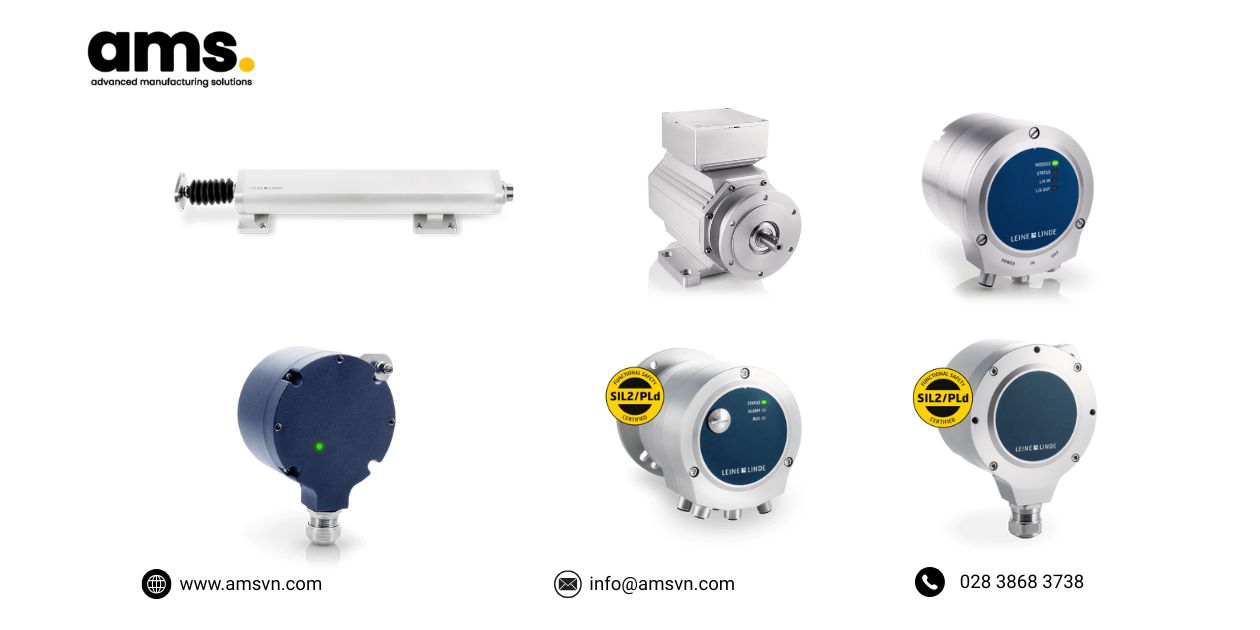
3.1. Linear 4000 Series
Highlighted models:
-
RLA 4200 - Inductive absolute encoder
-
RLI 4300 - Incremental linear encoder made of stainless steel
These encoders provide highly accurate absolute position values with fast response times, ideal for length measurement and gap control in steel rolling processes. Thanks to robust inductive scanning technology, they offer exceptional resistance to shock, heat, and vibration, ensuring stable performance under extreme conditions.
3.2. 1000 Extreme Series
Built for extreme environments, this series delivers maximum durability and performance. With a high protection rating, internal components are sealed from dust, moisture, and industrial contaminants. Encoders in this range can also be housed in stainless steel casings upon request, enhancing corrosion resistance in harsh settings.
The series supports a variety of incremental and absolute signal interfaces, including the option to combine both in a single device. Absolute communication protocols such as SSI, EnDat, and fieldbus standards ensure smooth integration into modern industrial automation systems.
3.3. 900 Premium Series - Absolute Encoders for Elevated Performance
The 900 Series offers advanced solutions for applications requiring precise multi-axis motion feedback and seamless system integration.
As industrial machinery becomes smarter and more complex, precision in movement control is key. The 900 Series employs absolute scanning technology to provide high-resolution position feedback, making it ideal for intelligent equipment in steel processing lines.
These encoders are purpose-built for extreme steel industry environments - capable of withstanding high temperatures, heavy vibrations, humidity, and repeated mechanical shocks.
They support an extensive range of communication interfaces, including EnDat, SSI, PROFIBUS, PROFINET, EtherNet/IP, and DRIVE-CLiQ. Optional models feature separate incremental outputs for consistent motion feedback.
A standout feature is the FSI 900 variant, which includes an integrated programmable functional safety system. This enables safe monitoring of parameters like speed, position limits, acceleration, standstill detection, and other safety-critical functions.
3.4. 800 Heavy Duty Series
The 800 Heavy Duty encoder series has stood the test of time, delivering stable performance in harsh industries such as steel manufacturing, paper production, marine, and wind energy-all sectors where reliability and durability are non-negotiable.
These encoders feature a robust mechanical design, including dual heavy-duty industrial bearings and a highly resistant enclosure, making them ideal for environments with extreme physical and environmental stress.
The 800 series can be optionally equipped with Leine Linde's ADS Uptime™ diagnostic system, allowing condition-based maintenance for maximum uptime.Safety-critical applications are also supported with variants that meet functional safety certifications, and ATEX/IECEx-certified versions are available for hazardous environments.
3.5. FSI 900 - Functional Safety Encoder
Certified SIL2/PLd safety - safe speed, position & acceleration monitoring.
More than just an absolute encoder, the FSI 900 demonstrates Leine Linde's engineering focus on user-specific challenges in safety-critical environments.
With SIL2/PLd Category 3 certification, this encoder ensures speed, acceleration, and end-position limits are met within safe functional boundaries—critical for equipment safety in steel manufacturing plants and other high-risk applications.
3.6. FSI 800 - Compact Functional Safety with Built-in Diagnostics
The FSI 800 encoder is a compact yet powerful solution with integrated square-wave signal monitoring. Upon detecting a fault, the encoder immediately switches to a safe state, eliminating the need for additional encoders or external sensors to achieve safety compliance.
This reduces installation space, minimizes the number of cables, and helps prevent failures caused by environmental interference, signal noise, or wear and tear.
Traditional single-encoder solutions often relied on 1Vpp signals, which operate at just 5VDC—unsuitable for heavy industrial environments. The FSI 800 addresses this limitation with robust HCHTL signals (9-30 VDC), capable of reliable transmission over 300+ meters of cabling.
Certified to SIL2/PLd, Category 3 standards, this encoder is ideal for 24/7 operations in industries like steel and paper-meeting Machinery Directive and relevant C-type standards.
4. Why Should Steel Plants Choose AMS?

Today, Leine & Linde operates under the renowned HEIDENHAIN Group. As the exclusive distributor of HEIDENHAIN in Vietnam, AMS is the trusted local partner for steel manufacturers seeking high-performance encoders designed for heavy-duty industrial environments.
At AMS, we are committed to delivering not just products, but technical value and reliable service:
-
Industry Insight - Machine Expertise
Our experienced engineering team understands rolling mill systems, heavy-duty motors, and the specific encoder requirements in the steel industry.
-
100% Genuine - Trusted Warranty
As an official distributor of Leine & Linde encoders in Vietnam, we guarantee authentic products with full warranty and after-sales support.
-
Correct Model Recommendation - Flexible Delivery
We provide application-based consultation, on-site inspections, and can support demo units when needed to ensure optimal performance for your equipment.
5. Conclusion
AMS is proud to offer Leine & Linde encoder solutions specifically tailored for the steel industry. If you are looking for expert advice or competitive pricing, contact AMS today for a detailed consultation. Thank you for your trust!
AMS Company, Ltd.243/9/10D To Hien Thanh, Ward 13, District 10
Hot line: 028.3868 3738/3903 - Fax: 028.3868 3797