
How to Achieve a Mirror Finish in Jewelry Manufacturing with Diamond Grinding Points

Posted by Social AMS on 04th Nov, 2025
Achieving a Mirror Finish in Jewelry Manufacturing with Diamond Grinding Points. Diamond grinding points have become the standard choice for jewelry manufacturers who demand exceptional precision in grinding and polishing. Drawing from AMS's experience supplying polishing solutions for Vietnam's leading luxury jewelry brands, this guide explains how to achieve a flawless mirror finish using diamond grinding points. How do jewelers achieve the highest brilliance and subtle light reflection? Why does surface perfection influence consumer appeal? Let's explore the answers below.
1. Jewelry Manufacturing Market Overview
The global demand for jewelry continues to grow alongside rising consumer income. According to Fortune Business Insight, the jewelry market was valued at USD 232.94 billion and is projected to reach USD 343.90 billion by 2032, with a CAGR of 5.10% during 2025-2032.
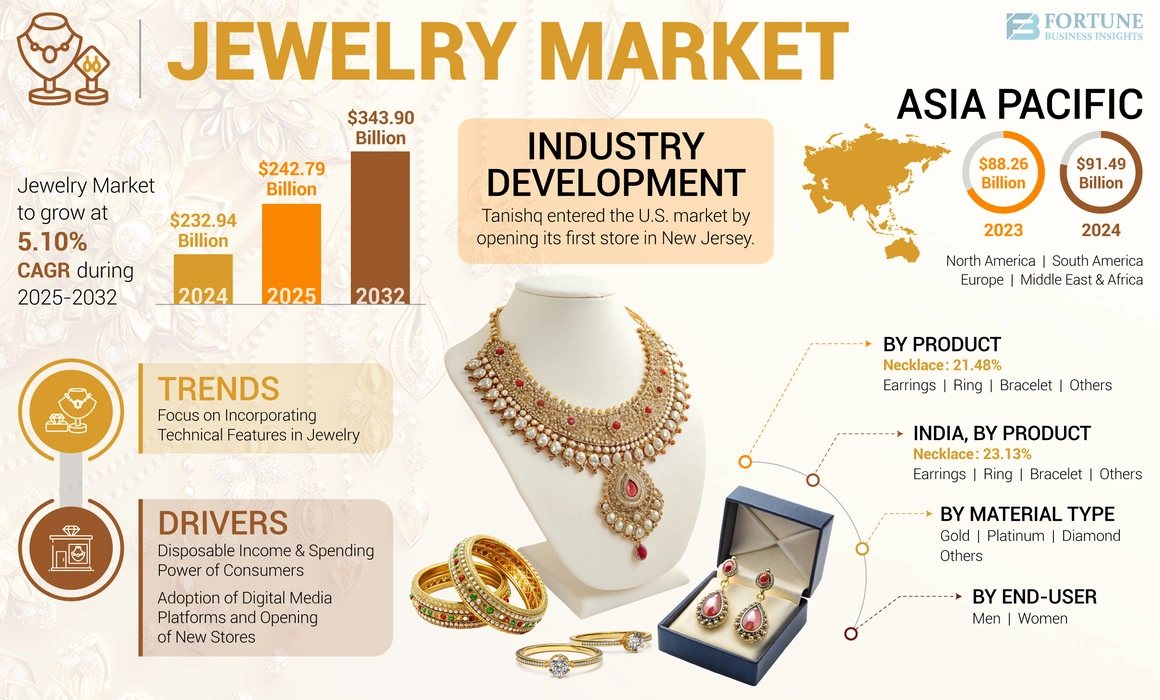
This growth is driven by increasing disposable income and online sales, fueled by social media and influencer marketing that shape consumer preferences. As a result, jewelry manufacturers face stricter quality standards and higher expectations in polishing and finishing.
In Vietnam, Mr. Hoang The Ngu, Chairman of the Vietnam Gemstone Association (VGA), noted that the local gemstone market holds vast potential due to its rich natural resources. Domestic demand for gemstones is rising especially in jewelry and feng shui applications and Vietnam now exports to Japan, Thailand, and Europe.
Meanwhile, the entry of international brands like Pandora and Swarovski has intensified competition in the premium jewelry segment, driving innovation and higher craftsmanship standards.
Market reports clearly show long-term growth, creating opportunities for industries that support jewelry manufacturing including grinding and polishing tools.
According to the U.S. Geological Survey, the global diamond cutting and polishing market is rebounding, supported by rising consumer interest in ethically sourced gemstones and advances in cutting technology. The natural diamond cutting and polishing market is forecasted to reach USD 32.1 billion by 2024, growing at a steady 8.5% rate.
In jewelry production, product value is often reflected in brightness, surface perfection, and light reflection. Modern manufacturers seek not just individual tools like diamond burs or ultrasonic cleaners, but complete solutions that optimize cost, labor, and sustainability, a real challenge for local distributors in Vietnam.
2. Technical Challenges in Jewelry Polishing
Jewelry finishing is far more complex than machining large metal blocks. It involves meticulous multi-step processes that demand precision, material knowledge, and skilled handling. Below are key technical challenges jewelry manufacturers face when polishing, along with why understanding them is essential to avoid surface defects.
2.1. Difficult Material Properties
-
Gemstones such as crystal, zirconia, and sapphire have a Mohs hardness of 7-10, much higher than common metals.
-
These materials are brittle and prone to cracking if grinding pressure or heat is excessive.
-
Achieving a mirror surface finish (Ra < 0.02 µm) requires extremely precise control of grinding forces and temperature.
2.2. Sensitivity to Microscopic Errors
-
Even a micron-level deviation in pressure or angle can cause surface haze or reduce optical reflectivity.
-
To maintain flawless results, tools must have uniform abrasive distribution, sharp cutting edges, and high thermal resistance qualities that diamond tools naturally deliver.
>> See more: Methods of Plastic Mold Polishing: Manual vs. Modern Machinery
3. Polishing Solutions for Jewelry Manufacturing
3.1. What Are Diamond Grinding Points?
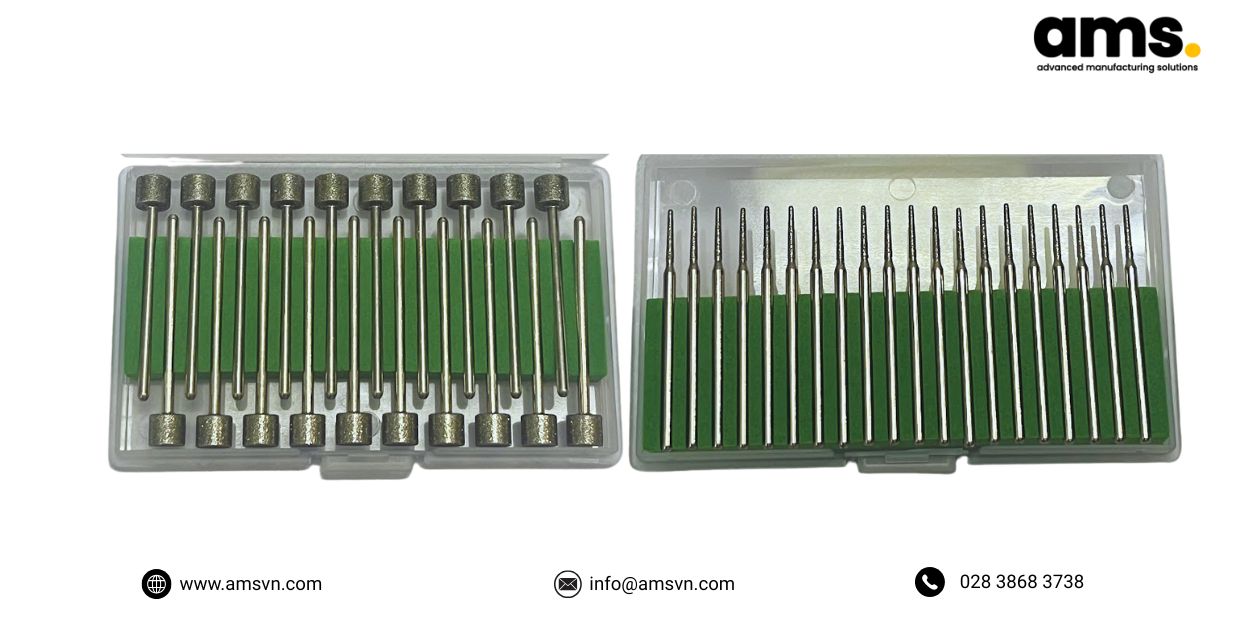
Diamond grinding points are precision tools made of nickel-plated diamond grit bonded to a stainless steel or brass shank. The diamond particles act as tiny cutting edges, creating a uniform abrasive surface rather than separate blades.
They come in various shapes conical, cylindrical, spherical, and more allowing jewelers to engrave, shape, or contour intricate gemstone and metal surfaces with high precision.
3.2. Applications of Diamond Grinding Points in Jewelry Making
Diamond grinding points are widely used in multiple jewelry processes, including:
-
Shaping and contouring gemstones into specific designs or facets
-
Widening internal diameters and finishing holes or settings
-
Deburring, threading, and engraving fine details
-
Trimming or refining precious metals such as gold, silver, and platinum
-
Grooving or resizing prong settings for stone placement
-
Pre-polishing surfaces before applying diamond paste or buffing compounds
To maintain tool efficiency and lifespan, always cool with water and avoid excessive pressure during operation.
4. AMS - Supporting Vietnam's Jewelry Manufacturing Growth
AMS understands the rigorous quality requirements of gemstone and jewelry producers. Our clients trust AMS because:
-
We provide high-precision polishing solutions using diamond grinding points, diamond paste, and polishing fluids from international brands such as Hyperion and Kemet.
-
We don't just sell tools, we advise on abrasive grain selection, grit size, and tool grades to help manufacturers achieve superior finishes, reduce costs, and improve productivity.
If you're a jewelry manufacturer seeking a trusted, professional, and results-driven partner, AMS is your ideal distributor for international-standard polishing solutions.
5. Conclusion
High-quality diamond grinding points are key to achieving exquisite mirror finishes that enhance a jewelry piece's brilliance and perceived value. Conversely, poor-quality tools can cause surface imperfections, reducing optical clarity and overall appeal. Contact AMS today to explore how our diamond tools can help you craft jewelry that radiates perfection in every detail.
AMS Company, Ltd.243/9/10D To Hien Thanh, Ward 13, District 10
Hot line: 028.3868 3738/3903 - Fax: 028.3868 3797