
Heidenhain Encoder Signal Loss: Troubleshooting and Repair Guide for CNC Systems

Posted by Social AMS on 03 Mar, 2026
AMS understands that many manufacturers and maintenance teams are looking for reliable ways to troubleshoot and repair Heidenhain encoder signal loss. With over two decades of field experience and manufacturer-aligned technical standards, we provide a practical diagnostic framework to help you resolve faults correctly and prevent repeat failures.
Heidenhain encoders are the core feedback devices in machining centers, CNC machines, robotic arms, and precision positioning systems. When the feedback signal from the encoder is lost, the control system will alert the machine to report the error and temporarily stop the machine.
For operators, this often appears as an unexplained machine fault. For maintenance teams, it becomes a race against downtime and production loss. This guide focuses on Heidenhain encoder troubleshooting, root-cause analysis, and repair/replace decisions, with the ultimate goal of restoring stable machine operation and avoiding recurring faults.
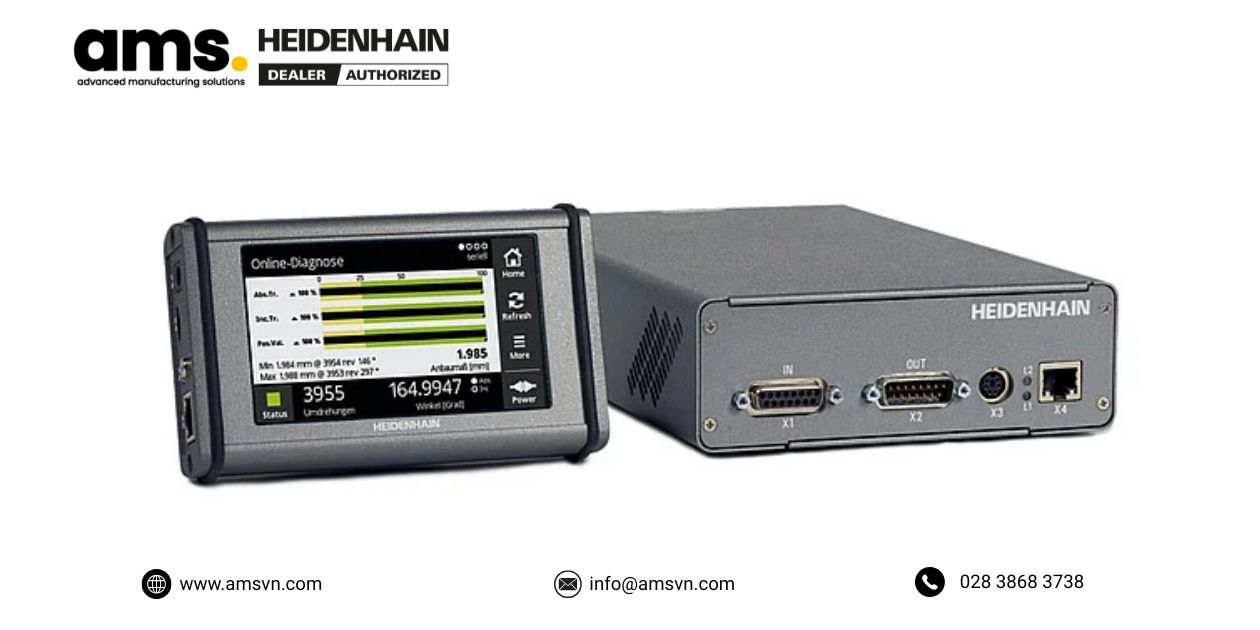
1. Common Causes of Heidenhain Encoder Failure
Industry experts agree that most encoder failures are electronic in nature, but the root causes often come from mechanical and environmental factors.
1.1. Bearing Wear and Vibration
Unstable operation can originate from worn bearings inside or near the encoder assembly. When this happens:
-
The drive must continuously compensate for missing or inconsistent pulses
-
Incorrect bearing installation accelerates wear
-
Mechanical vibration increases over time
-
Intermittent signal loss begins to appear
Early mechanical degradation often shows up first as unstable or fluctuating feedback signals.
1.2. Contamination: Dust, Oil, Coolant, and Moisture
Contamination is one of the most frequent hidden causes of encoder signal loss. Field repair centers report that:
-
Dust buildup on the scale or code disc can distort readings
-
Fine particles may cause two incremental lines to be read as one
-
Pulse counts become inaccurate
-
Signal edges become irregular before total failure occurs
Moisture intrusion is another critical risk:
-
Often enters through cable connectors
-
Causes intermittent encoder errors
-
Common in humid workshops
-
Frequently appears after machine washdown or during morning condensation
1.3. Temperature and Overheating
Encoders exposed to continuous high-temperature airflow — such as hot motor fan exhaust — are at risk.
High temperature can:
-
Shift electronic thresholds
-
Degrade internal components
-
Shorten encoder lifespan
-
Cause progressive signal distortion before total failure
Typical Encoder Signal Loss Symptoms vs Possible Causes
| Symptom at drive or test equipment | Likely underlying causes (from sources and field cases) | Suggested next checks |
|---|---|---|
| No feedback at all, alarms immediately at power-up, flat line on measured channels | No supply voltage or wrong supply level, unplugged connector, fully open wire at receiving device, incorrect interface type configured | Confirm encoder supply voltage at the connector, verify pinout and interface type against Heidenhain documentation, perform continuity checks from encoder to drive, re-seat and inspect connectors |
| Very low-amplitude waveform that barely resembles a square wave, sometimes present only on one channel | Open wire on that channel with crosstalk from neighboring channels, poor terminal contact at encoder or drive, damaged cable conductor | Inspect and re-terminate screw terminals, verify continuity on the affected channel, gently flex cable while watching the signal to locate intermittent opens |
| Intermittent encoder alarms, often after washdown, during humidity changes, or when cables are moved | Loose or corroded connectors, moisture ingress through cable glands, contamination on incremental disc or linear scale, vibration loosening terminals | Inspect cable glands and seals for moisture, dry and clean accessible encoder components, monitor signals while inducing gentle vibration to see if faults correlate |
| Lost counts, position drift, or contour errors without full encoder loss alarm | Dirt or dust on incremental disc causing mis-read lines, mechanical misalignment, worn bearings causing wobble, axis speeds exceeding encoder tracking capability | Clean encoder optics or linear scales per manufacturer guidance, verify mechanical coupling and alignment, compare commanded speed to encoder and drive limits |
| Encoder alarms only at high speed; sine/cosine waveforms appear clipped on a scope | Encoder signal amplitude higher than drive input spec, as in the 1.2 Vpp example on a 1.0 Vpp input, or inadequate signal scaling on interface board | Measure amplitude at the drive input, compare to drive limits, consult encoder and drive manuals about allowable Vpp and any configuration options, avoid ad-hoc attenuation that may degrade signal quality |
This type of symptom cause matrix is commonly referenced across industrial repair communities and technical forums. While not exhaustive, it reflects the most frequently observed real-world failure patterns.
2. Recommended Process for Heidenhain Encoder Repair or Replacement
Not every Heidenhain encoder must be sent to a repair center, and not every issue requires full replacement. The following is a reference workflow recommended by AMS.
2.1. Off-Machine Encoder Service Workflow (Reference)
For certain encoder types, off-machine service may include:
-
Safe removal from the machine
-
Careful disassembly with documentation
-
Inspection for wear, damage, or contamination
-
Cleaning and relubrication of mechanical parts (if applicable)
-
Replacement of failed non-OEM components
-
Correct reassembly and sealing
-
Functional testing before reinstallation
This workflow is typically feasible only for simpler encoder models and qualified service environments.
2.2. On-Machine Maintenance Actions
Internal maintenance teams can often perform:
-
Connector repair
-
Cable replacement
-
Supply voltage correction
-
Basic cleaning of accessible encoder surfaces
These actions should always follow manufacturer guidelines.
2.3. Using Heidenhain Test and Diagnostic Equipment
Heidenhain provides dedicated encoder testing and diagnostic tools that support:
-
Setup verification
-
Signal monitoring
-
Interface identification
-
Acceptance testing of machine tools
-
Static and dynamic motion measurement
Grid encoders and test devices from Heidenhain are especially effective for CNC accuracy verification and commissioning tests.
3. FAQ: Heidenhain Encoder Troubleshooting and Repair
3.1. How Do I Know If the Encoder Is Faulty or the Wiring Is the Problem?
Use a structured comparison method:
Step 1: Basic Electrical Checks
-
Verify supply voltage
-
Check cable continuity
-
Inspect connector integrity
Step 2: Signal Measurement
Check output signals using an oscilloscope or Heidenhain test device
Step 3: Known-Good Encoder Swap Test
-
Install a known-good encoder on the same cable and drive
-
If the new encoder works normally → original encoder is likely faulty
-
If both encoders fail on the same axis but work on another axis → problem likely lies in:
-
Drive
-
Interface board
-
Cabling system - not the encoder itself
-
This is one of the most reliable Heidenhain encoder troubleshooting methods used in practice.
3.2. Is Dedicated Heidenhain Test Equipment Necessary?
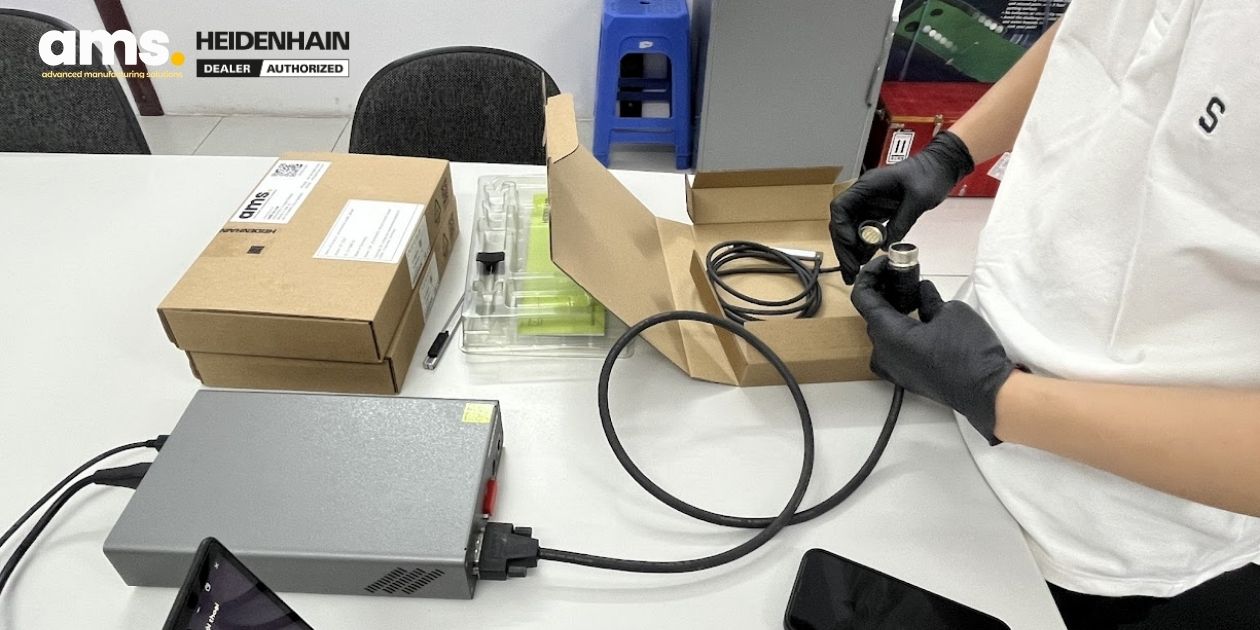
Specialized tools such as Heidenhain PWM 20/21 with ATS software provide significant advantages:
-
Automatic interface detection
-
Manufacturer-specific test routines
-
Standardized test reports
-
Faster setup and troubleshooting
-
Better documentation than a standalone oscilloscope
For facilities handling multiple Heidenhain encoders, dedicated testers can significantly reduce diagnostic time and uncertainty.
Modern Heidenhain encoders also support:
-
Built-in diagnostics
-
Condition monitoring
-
Predictive maintenance strategies
-
Real-time status data for digital models and optimization
Advanced users can leverage these features to reduce unplanned downtime and improve total ROI.
3.3. When Should You Stop Troubleshooting and Replace the Encoder?
You should consider Heidenhain encoder replacement when:
-
Wiring and power issues have been ruled out
-
Oscilloscope or tester shows distorted or missing signals
-
Signal quality does not recover after cable or drive substitution
-
Output does not meet specification
At this stage, continued troubleshooting may waste production time. Replacement or authorized repair becomes the most efficient path forward. Always consult an authorized Heidenhain distributor for correct model selection and repair guidance.
4. Conclusion
AMS is the exclusive authorized Heidenhain distributor in Vietnam. Beyond supplying advanced measurement and encoder solutions, we provide manufacturer-trained technical support for diagnostics, repair consultation, and replacement planning.
If you are facing Heidenhain encoder signal loss or need expert troubleshooting support, contact AMS today. Our engineering team is ready to evaluate your case and recommend the most effective technical solution for your operation.
AMS Company, Ltd.243/9/10D To Hien Thanh str, Hoa Hung Ward, HCMC, Vietnam
Hot line: 028.3868 3738/3903 - Fax: 028.3868 3797